
Opinion
Public Trust Online Is Breaking — And We Should Take It Seriously
|
Getting your Trinity Audio player ready...
|
Public trust online is becoming fragile.
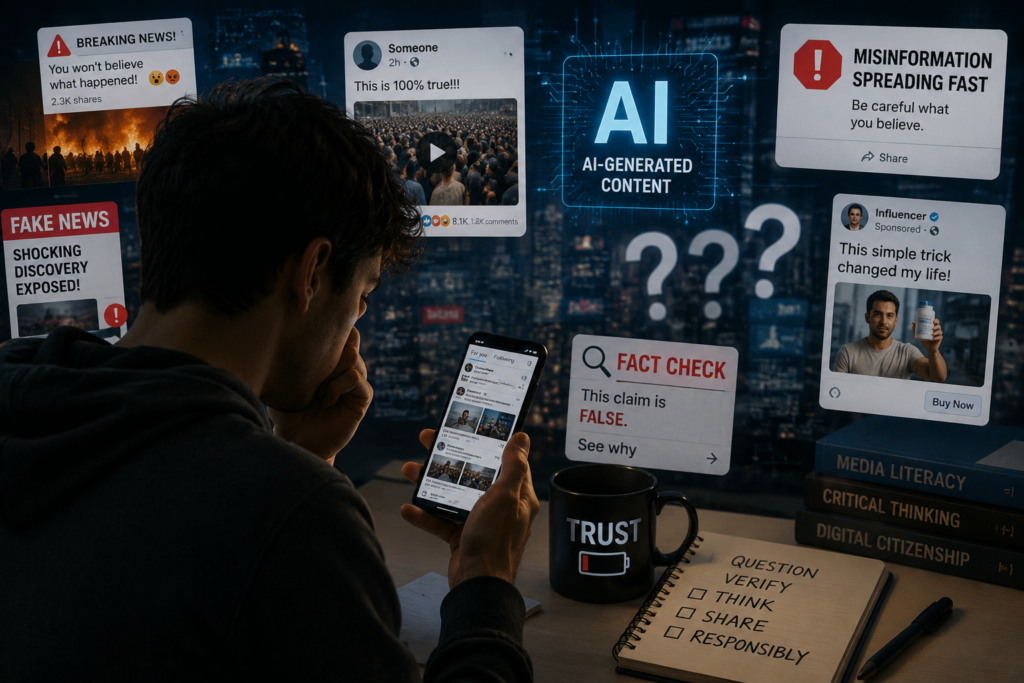
Every day, people scroll through social media feeds filled with news, opinions, videos, screenshots, rumours, AI-generated images, emotional headlines, and arguments from strangers. Some of it is true. Some of it is misleading. Some of it is completely false.
The problem is not only that misinformation exists. The deeper problem is that people are becoming exhausted by the effort of deciding what is real.
The Internet Changed Public Life
The internet gave ordinary people a voice. That was a powerful change. It allowed citizens, minorities, independent writers, small publishers, and activists to speak without waiting for permission from traditional institutions.
That freedom still matters.
But the same system also created a new kind of confusion. False information can travel quickly. Anger can be rewarded. Serious reporting can sit beside conspiracy theories, propaganda, advertising, and AI-generated content that looks convincing at first glance.
When everything appears in the same feed, truth becomes harder to recognise.
AI Makes Trust Even Harder
Artificial intelligence adds another layer to this problem.
AI can help people write, translate, analyse, create images, and understand complicated subjects. Used responsibly, it can support education and public knowledge.
But AI can also produce fake content at scale. It can imitate people, generate false images, create misleading summaries, and flood the internet with material that looks polished but may not be reliable.
That does not mean society should reject AI. It means society must become more serious about verification.
Trust Needs Human Responsibility
Public trust online cannot be repaired by technology alone. Platforms need better rules. Governments need careful regulation. Journalists need stronger standards. Citizens need media literacy. Schools need to teach young people how to question digital information.
But above all, we need a culture that values truth more than speed.
Sharing something should not be treated as harmless just because it takes one second. A false post can damage reputations, divide communities, mislead voters, and create fear.
The future of public debate depends on whether people can still agree that facts matter.
If trust disappears completely, democracy becomes weaker. Public conversation becomes louder but less meaningful. People stop listening and start choosing whichever version of reality comforts them.
Public trust online is breaking. We should take it seriously before the damage becomes normal.