
International
China Defends Its Technology Rise as AI and Semiconductor Rivalry Grows
|
Getting your Trinity Audio player ready...
|
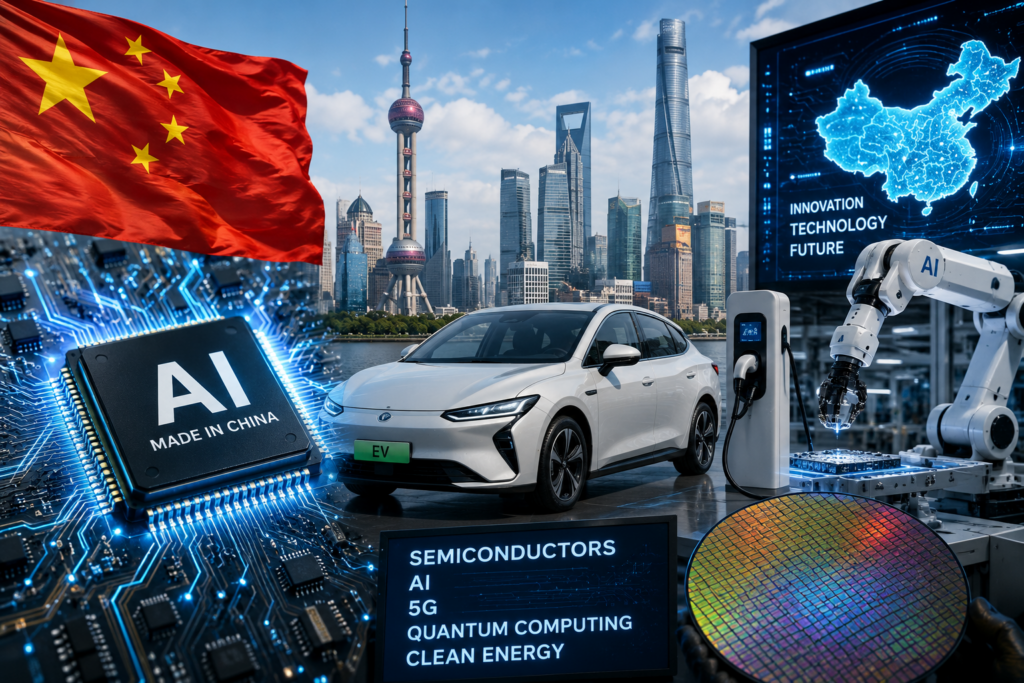
China has defended its rapid rise in advanced technology, rejecting claims that government subsidies alone are behind its growing strength in artificial intelligence, electric vehicles, quantum computing and semiconductors.
The debate is becoming one of the most important economic and political questions of the modern world. Technology is no longer only about business. It is about power, security, trade, national influence and the future direction of the global economy.
Chinese Premier Li Qiang said China’s progress in frontier technologies is driven by innovation, research and large-scale private investment. His comments come at a time when Western governments are increasingly concerned about China’s role in global technology supply chains.
At the centre of this debate are industries that will shape the next century: AI, chips, clean energy, electric vehicles, robotics and quantum computing. Whoever leads in these fields will not only build successful companies; they will also influence military systems, financial markets, public services and everyday life.
Huawei has become one of the most symbolic companies in this global contest. Despite years of foreign restrictions, the company remains a major player in telecommunications, smartphones, cloud technology and AI-related infrastructure. For China, Huawei is often presented as an example of resilience. For Western governments, it remains a focus of security and competition concerns.
The argument over subsidies is also important. The United States and parts of Europe have accused China of using state support to give its companies an unfair advantage. China rejects this and argues that its companies are succeeding because of engineering talent, industrial planning, competition and investment.
The truth is more complex. Modern technology competition is rarely separated from government policy. The United States supports its chip industry. Europe funds green technology and industrial projects. China supports strategic sectors. In today’s world, every major power understands that technology leadership cannot be left completely to chance.
For smaller countries, this rivalry creates both risk and opportunity. Cheaper electric vehicles, solar panels and digital infrastructure can help developing nations modernise faster. But heavy dependence on one technology power can also create political pressure, cybersecurity concerns and supply chain vulnerability.
This is why the global technology race needs more than slogans. The world needs fair competition, open standards, strong cybersecurity rules and serious international discussion about AI safety and emerging technologies.
AI and semiconductors are especially sensitive because they sit at the heart of both civilian and military development. The same technology that can improve medicine, education and productivity can also be used for surveillance, cyber operations and weapons systems.
China’s message is clear: it wants recognition as a serious technology power, not just as the world’s factory. The West’s message is also clear: it does not want to become dependent on Chinese technology in sectors linked to security and economic control.
This rivalry will not disappear soon. It will shape trade policy, investment decisions, university research, defence planning and consumer markets for years to come.
For ordinary people, the impact will be visible in the products they buy, the cars they drive, the apps they use and the jobs their economies create. The global technology race is not happening far away. It is already entering homes, workplaces and governments around the world.
The challenge now is to make sure innovation serves people, rather than turning technology into another battlefield for global dominance.