
Analysis
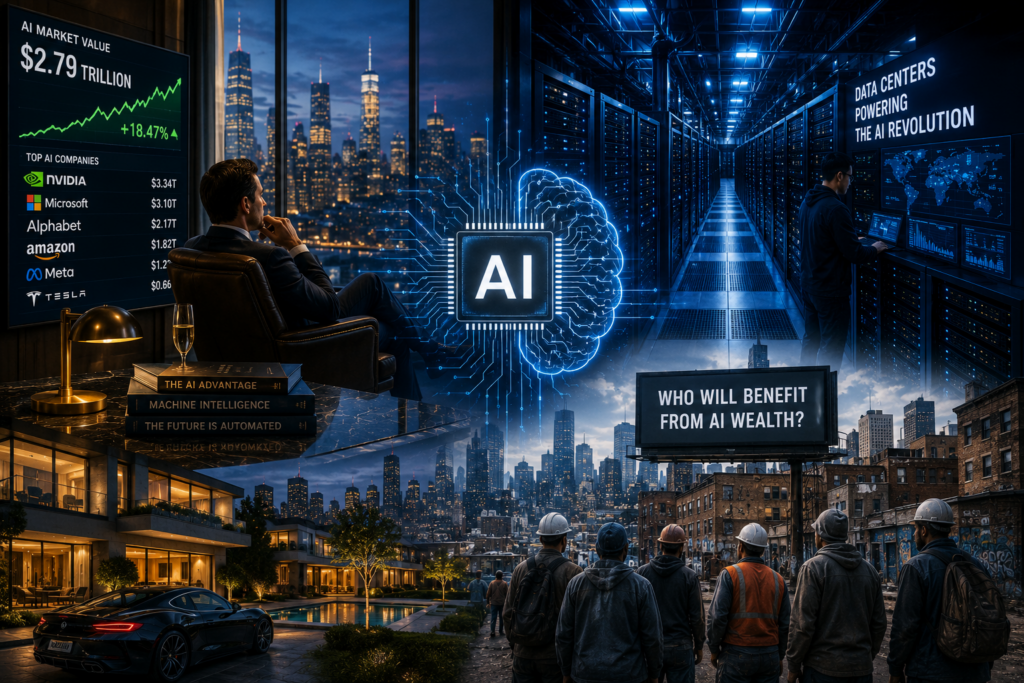
AI Wealth Is Growing Fast, but Who Will Really Benefit?
|
Getting your Trinity Audio player ready...
|
Artificial intelligence is already creating enormous wealth. The harder question is who will receive it.
Across the world, investors are pouring money into AI companies, chipmakers, data centres and cloud infrastructure. The biggest technology firms are becoming even more powerful. Their valuations rise when they announce new models, new chips, new partnerships or new AI tools.
But behind the excitement, a serious social question is growing.
If AI becomes one of the most profitable technologies in human history, will that wealth improve society broadly, or will it mostly stay with a small group of companies, executives and investors?
The New AI Economy
AI is not only a product. It is becoming infrastructure.
It is entering search engines, office software, coding tools, customer service, finance, healthcare, media, education and defence. Companies are using it to automate tasks, reduce costs and increase productivity.
That means AI may not create wealth in one industry only. It could reshape many industries at once.
Reuters Breakingviews recently argued that the debate over AI wealth-sharing should begin now, not later, because the technology’s economic impact could become enormous and difficult to control after power is already concentrated. (Reuters)
That is the important point: waiting until after wealth is concentrated may be too late.
Big Companies Are Moving First
The companies best positioned to benefit from AI are already powerful.
They own cloud platforms, chip supply chains, data centres, software ecosystems, app stores, advertising networks and huge amounts of data. Smaller firms may innovate, but they often depend on the giants for computing power, distribution or investment.
This creates a risk.
AI may increase productivity for everyone, but profits may flow mainly to those who own the platforms. Workers may use AI tools every day while the financial rewards go upward to shareholders.
That is not new. Many previous technology revolutions created wealth while also increasing inequality. The difference with AI is speed and scale.
Workers Need a Real Share
A serious AI economy must include workers.
If AI helps a company produce more with fewer people, the gains should not only become higher executive pay or bigger stock buybacks. Workers need training, wage growth, shorter working hours, stronger rights and realistic support when jobs change.
Otherwise, AI will be seen not as progress, but as a threat.
People will not support a technology that makes their lives more insecure while making billionaires richer.
This is why governments must think beyond regulation of safety. They also need economic planning: education, tax policy, competition rules, labour protections and public investment.
Public Money, Private Profit
There is another issue: many technology breakthroughs depend on public support.
Universities, government research, defence funding, public infrastructure and publicly educated workers often help create the foundation for private success. Yet when the profits arrive, society does not always receive a fair return.
If public systems help build the AI future, then the public should benefit too.
That does not mean governments should control every AI company. But it does mean societies should ask whether tax systems, public investment funds, competition policy and data rules are strong enough for the age of AI.
AI Should Serve People
The AI debate is often dominated by technical questions. How powerful are the models? How fast are the chips? Which company is ahead? Which country will win?
Those questions matter, but they are not enough.
The deeper question is human: what kind of society will AI create?
Will it help doctors treat patients faster? Will it help teachers support students better? Will it help small businesses compete? Will it reduce boring work and give people more time?
Or will it mostly monitor workers, replace jobs, spread misinformation, strengthen monopolies and increase inequality?
Technology does not answer those questions by itself. Politics, law and public pressure answer them.
The Future Is Not Automatic
Many people talk about AI as if its future is already decided. It is not.
AI could become a tool for shared prosperity. It could also become a machine for concentrating power.
The difference will depend on choices made now.
Governments should protect competition. Workers should receive training and rights. Public institutions should use AI carefully and transparently. Companies should be pushed to prove that their tools help society, not only shareholders.
AI wealth will not share itself.
If societies want a fairer future, they must design one.
The Real Lesson
The question is not whether AI will create wealth. It already is.
The real question is whether that wealth will create a better world.
If AI only makes the rich richer, public trust will break. If it improves healthcare, education, productivity and living standards, it could become one of the most important tools of the century.
The future of AI should not belong only to those who own the servers.
It should belong to the people whose lives will be changed by it.