
Bangladesh
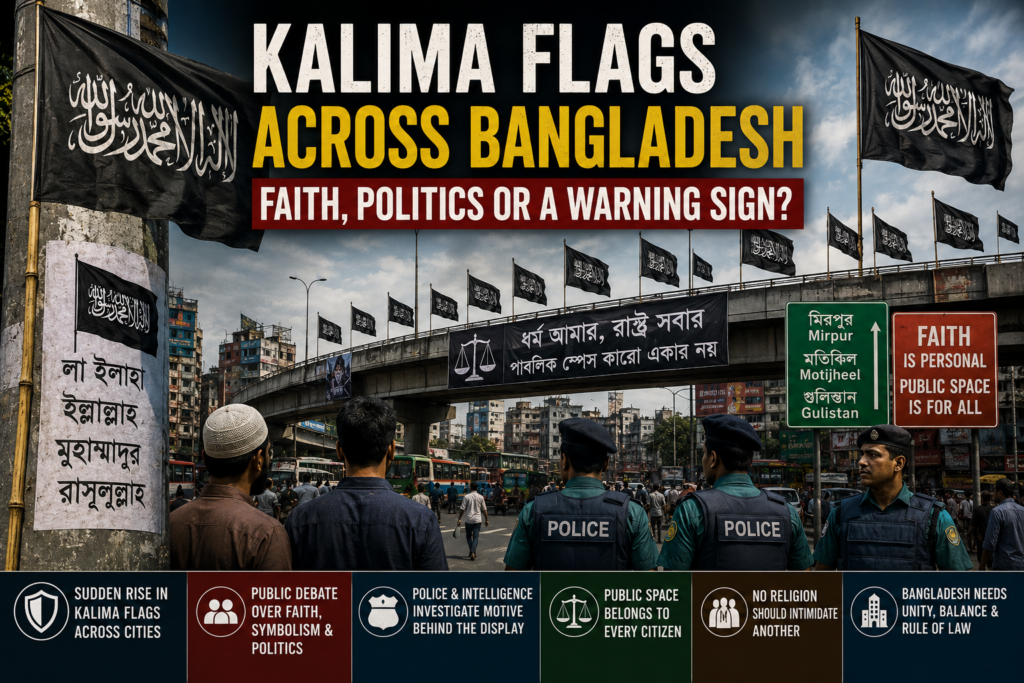
Kalima Flags Across Bangladesh: Faith, Politics or a Warning Sign?
|
Getting your Trinity Audio player ready...
|
Bangladesh is now facing a strange and sensitive question: when does a religious symbol become a public security concern?
Over the past two weeks, flags bearing the Kalima have appeared on roads, bridges, flyovers and public spaces in Dhaka and several districts. Some people see them as a simple expression of faith. Others see a coordinated political message. Police and intelligence officials are now looking into the sudden spread.
This is not a small issue.
In Bangladesh, religion is never only religion when it enters the street at scale. It becomes identity. It becomes power. It becomes emotion. Sometimes it becomes a tool for groups that want to test the state, frighten minorities or claim public space in the name of faith.
That is why the country needs calm, honest discussion.
Not panic.
Not hatred.
Not blind acceptance either.
Faith Is Personal, Public Space Is Political
Every citizen has the right to believe.
A Muslim has the right to respect the Kalima. A Hindu has the right to worship. A Buddhist, Christian, atheist or non-religious person has the right to live without fear. A democratic country must protect all of them.
But public space belongs to everyone.
A bridge does not belong to one religion. A road does not belong to one group. A flyover does not become sacred because someone hangs a religious flag on it. Public space must remain shared, safe and politically neutral enough for all citizens to feel they belong.
That is where the debate begins.
If people put up religious flags at home, in mosques or during religious events, that is one thing. But if flags suddenly appear across roads, processions, public infrastructure and city routes, the state has the right to ask questions.
Who organised it?
Who funded it?
Why now?
Is it spontaneous faith, or coordinated mobilisation?
Those questions are not anti-Islam.
They are basic public responsibility.
Bangladesh Has Seen Symbol Politics Before
Symbols are powerful because they do not need long speeches.
A flag can say what a thousand slogans cannot. It can unite people. It can inspire emotion. It can also create pressure and fear.
Bangladesh has seen how quickly symbols can become political. Party flags, religious slogans, student banners, national colours, foreign football flags and protest signs all carry meaning depending on timing and place.
The Kalima is sacred to Muslims. That makes it even more sensitive.
No responsible person should insult it. But no responsible state should ignore how sacred symbols can be used by political or extremist groups.
History shows that religious language often becomes most dangerous when it is taken out of personal faith and placed into mass political display.
That is when the line between devotion and mobilisation can become blurred.
The State Must Investigate Without Provoking Fear
The authorities need to act carefully.
If there is no organised threat behind the flags, the public should be told clearly. If there is a coordinated campaign, the public deserves to know who is behind it. If any banned group is involved, the law must act. If it is only emotional religious expression, the response should be measured.
The worst option is silence.
Silence creates rumours. Rumours create fear. Fear creates reaction. Reaction can become violence.
Bangladesh cannot afford that.
Police and intelligence agencies should investigate the matter professionally, not theatrically. They should not harass ordinary believers. They should not create the impression that Islamic expression itself is criminal. But they must also ensure that no group uses religion to occupy public space, intimidate others or test the strength of the state.
This is a difficult balance.
But a serious country must be able to hold that balance.
Religion Should Not Become a Street Power Test
The deepest concern is not the flag itself.
The concern is whether religion is being used to measure power in public life.
If one group can cover public spaces with religious symbols today, another group may respond tomorrow. Then politics becomes a contest of who can dominate streets with sacred signs. That is dangerous in a multi-religious society.
Bangladesh belongs to Muslims.
Bangladesh also belongs to Hindus, Buddhists, Christians, Indigenous communities, atheists, secular citizens and people who do not want politics to be controlled by religion.
That is the promise of citizenship.
No group should feel that public space is being taken away from them by religious pressure.
A Muslim-majority country can respect Islam without turning every public road into a religious battleground. It can protect faith without surrendering the state to religious symbolism.
That is what maturity looks like.
Do Not Blame Ordinary Believers
It is important to be fair.
Many people supporting the flags may be ordinary Muslims acting from emotion, devotion or community identity. They may not have any political plan. They may genuinely believe the flags are a peaceful expression of faith.
They should not be demonised.
But good intentions do not remove public consequences.
A symbol can be sacred to one person and frightening to another if it appears suddenly, widely and without explanation. A public campaign can be peaceful at first and still create space for manipulation later.
That is why leadership matters.
Religious leaders should speak responsibly. Political parties should not exploit the issue. Police should avoid excessive force. Media should not sensationalise it. Citizens should not spread rumours.
Bangladesh needs clarity, not chaos.
The Timing Matters
Bangladesh is already politically sensitive.
The country is still dealing with the legacy of authoritarian rule, party tension, street mobilisation, security concerns, disinformation and public distrust. In that environment, any sudden symbolic movement can carry extra weight.
People are asking questions because the timing feels unusual.
Why now?
Why so quickly?
Why across different areas?
Why in public infrastructure?
These questions deserve answers.
Not because people hate religion, but because Bangladesh knows what happens when politics hides behind religious emotion.
A Secular State Protects Religion Better
Some people misunderstand secularism.
Secularism does not mean hatred of religion. It means the state does not belong to one religion or one clerical group. It means every citizen is protected under the same law.
In fact, secularism protects religion better than religious domination.
It protects Muslims from state misuse of Islam. It protects Hindus from majoritarian pressure. It protects minorities from fear. It protects atheists and free thinkers from forced belief. It protects public space from becoming a battlefield of sacred claims.
Bangladesh needs that principle now more than ever.
The state should protect the right to believe.
It should also protect the right not to be dominated by religious displays in public life.
The Real Lesson
The Kalima flag debate is not only about cloth, colour or Arabic script.
It is about the future of public space in Bangladesh.
Will public roads belong to all citizens, or will they become arenas of religious pressure?
Will faith remain a matter of conscience, or will it become a tool of mobilisation?
Will the state investigate calmly, or will rumours control the story?
Bangladesh must be careful.
It must respect Islam without allowing anyone to weaponise Islam.
It must protect believers without frightening minorities.
It must defend public order without insulting faith.
And above all, it must remember that a country is strongest when every citizen can walk through public space without fear.
Faith should live in the heart.
The state should belong to everyone.