
Analysis
World Bank’s $1.1bn Emergency Support Shows Bangladesh’s Economy Is Under Pressure
|
Getting your Trinity Audio player ready...
|
Bangladesh has received a major financial lifeline, but no one should mistake it for comfort.
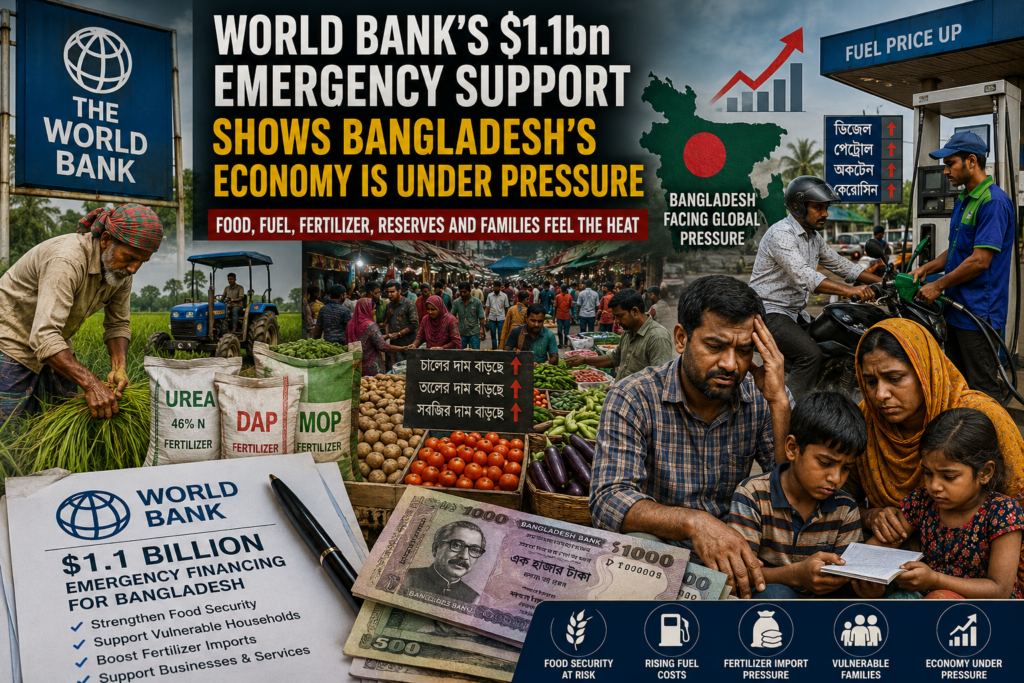
The World Bank has approved $1.1 billion in emergency financing for Bangladesh at a time when the country is under pressure from rising global prices, food security concerns, fuel costs, fertilizer needs and pressure on vulnerable households.
This is not just another development loan.
It is a warning.
When a country needs emergency support to protect food supply, energy needs and poor families, it means the economy is carrying real stress beneath the surface. Bangladesh may still be moving, producing and exporting, but ordinary people can feel the pressure every day in markets, transport costs, electricity bills and food prices.
A financial package can help.
But it cannot replace serious economic discipline.
Food Security Comes First
The most important part of this support is food security.
Bangladesh is a country where rice is not only a crop. It is daily survival. If fertilizer supply becomes uncertain, rice production can suffer. If rice production suffers, food prices rise. If food prices rise, poor families are hit first.
That is why emergency financing for fertilizer imports matters.
Farmers do not work with speeches. They work with seed, water, fertilizer, labour and timing. If any part of that chain becomes weak, the whole country feels it months later.
Bangladesh imports most of its fertilizer needs. That makes the country vulnerable when global prices rise or supply chains become unstable. A farmer in Rangpur, Rajshahi, Barisal or Mymensingh may have no control over world markets, but the cost reaches his field anyway.
That is the cruel reality of a connected economy.
Global Crisis, Local Pain
A conflict far away can raise prices in a Bangladeshi bazaar.
Fuel becomes more expensive. Fertilizer becomes more expensive. Food transport becomes more expensive. Electricity production becomes more costly. Businesses become cautious. Poor households cut spending. Middle-class families begin to feel poorer without changing their lifestyle.
This is how global shocks enter ordinary life.
People may not follow international finance. They may not read World Bank documents. But they understand when cooking oil costs more, vegetables cost more, transport costs more and savings disappear faster.
That is why this emergency package should not be discussed only as government finance.
It should be discussed as household survival.
Vulnerable Families Need Protection
The World Bank support is also expected to help vulnerable households and businesses affected by rising costs.
That is necessary.
When prices rise, the poor do not have many choices. They eat less protein. They delay medical care. They borrow money. They take children out of extra learning. They reduce transport. They survive quietly, often without appearing in official speeches.
Economic pressure is not always dramatic.
Sometimes it looks like a mother buying less fish.
Sometimes it looks like a father skipping medicine.
Sometimes it looks like a student walking instead of taking transport.
Sometimes it looks like a small shop owner wondering whether to close.
A responsible state must see these quiet struggles before they become a larger social crisis.
Emergency Money Must Not Be Wasted
Bangladesh needs this support, but it must use it carefully.
Emergency financing should not become another opportunity for corruption, inflated contracts, political favouritism or bureaucratic waste. Public money and borrowed money both carry responsibility.
Every dollar must be tracked.
Every import must be justified.
Every support programme must reach real people, not only connected groups.
If fertilizer support fails to reach farmers properly, food security will remain at risk. If cash or livelihood support is captured by local political networks, the poor will be betrayed again. If fuel and energy spending lacks transparency, public trust will weaken.
Bangladesh cannot afford waste at a time like this.
Farmers Are National Security
Bangladesh often talks about mega projects, foreign investment and GDP growth.
Those things matter.
But farmers are also national security.
If farmers cannot produce, the nation becomes vulnerable. If agriculture weakens, food prices rise. If food prices rise too much, social anger grows. No economy can stay stable when ordinary families cannot afford basic food.
That is why the government must treat agricultural inputs as a national priority.
Fertilizer must be available.
Prices must be monitored.
Middlemen must not be allowed to exploit shortages.
Small farmers must not be pushed out by rising costs.
A country that protects its farmers protects its future.
The Reserve Pressure Is Still Real
Emergency financing may help Bangladesh manage immediate needs, but it does not remove deeper pressure.
Foreign reserves, import bills, inflation, energy costs and debt obligations remain serious issues. Bangladesh must strengthen exports, improve remittance flows, reduce wasteful spending and rebuild confidence in economic management.
Loans can buy time.
They cannot solve everything.
The danger is when governments treat external support as success by itself. It is not. The real success is using that support to stabilise the economy and reduce future dependence.
Bangladesh should welcome World Bank support, but it must also ask why emergency support became necessary.
That question is uncomfortable.
But it is necessary.
Ordinary People Need Honest Communication
The government should speak honestly to the public.
People can handle difficult truth better than confusing silence. If global prices are rising, explain it. If fertilizer imports need support, explain it. If energy costs are under pressure, explain it. If social safety nets are being expanded, explain who will receive help and how.
Trust matters in economic crisis.
When people do not trust official information, rumours fill the space. Rumours create panic buying, political anger and public suspicion.
Clear communication is not decoration.
It is part of crisis management.
The Real Lesson
The World Bank’s $1.1 billion support gives Bangladesh breathing space.
But breathing space is not recovery.
The country must use this moment wisely. It must protect farmers, stabilise food supply, support vulnerable households, watch fuel and fertilizer costs, and prevent corruption in emergency spending.
Bangladesh cannot control every global shock.
But it can control how honestly and efficiently it responds.
The real test is not whether money arrives.
The real test is whether that money reaches the places where pressure is highest: the field, the market, the power system, the small business and the poor household.
A strong economy is not measured only by official numbers.
It is measured by whether ordinary people can still afford to live with dignity.