
Bangladesh
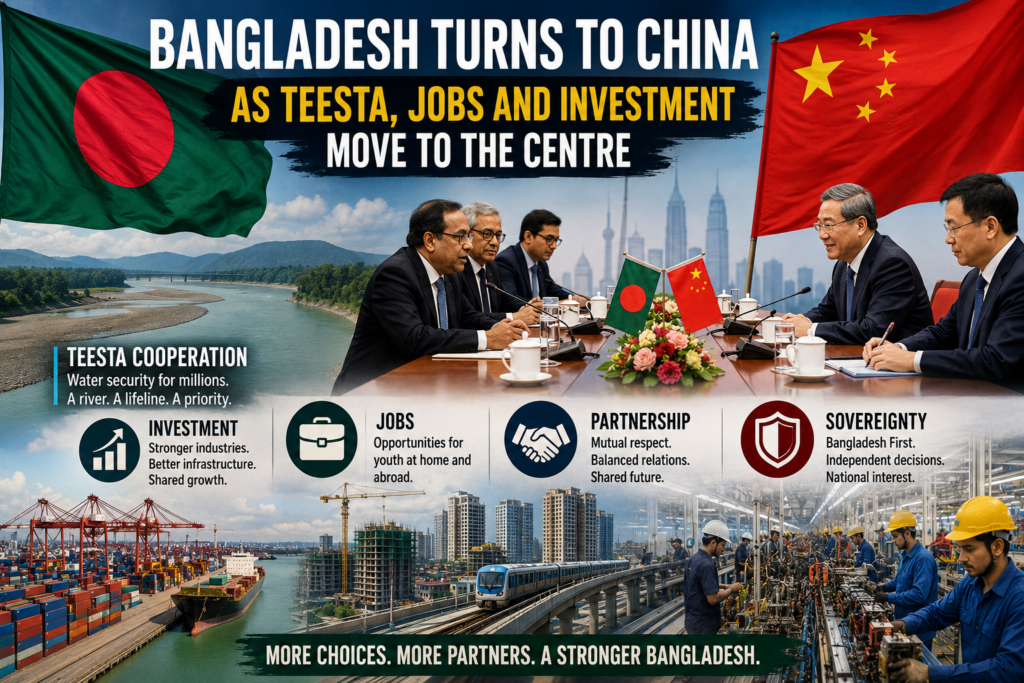
Bangladesh Turns to China as Teesta, Jobs and Investment Move to the Centre
|
Getting your Trinity Audio player ready...
|
Bangladesh’s latest China outreach is not just another diplomatic visit. It is a message.
Dhaka is telling the region that it will not sit quietly while its rivers, jobs and economic future remain trapped in delay. It wants investment. It wants employment opportunities. It wants movement on Teesta. And, most importantly, it wants more room to make decisions in its own national interest.
For years, Bangladesh has heard promises on water, development and regional cooperation. But promises do not irrigate fields. Promises do not create jobs. Promises do not stop river erosion. Promises do not feed families in the north.
That is why this visit matters.
Teesta Is About People, Not Just Diplomacy
Teesta is often discussed like a diplomatic file, but for Bangladesh it is much more personal than that.
It is about farmers waiting for water. It is about land becoming uncertain. It is about northern communities that cannot build a stable future when river management remains unresolved year after year.
When water politics becomes stuck, ordinary people pay the price.
Bangladesh has waited too long for a fair and practical solution. The long delay around Teesta has created frustration, and that frustration is now shaping Dhaka’s choices. If one door remains closed, Bangladesh has every right to look for another.
China’s involvement in river management and restoration is therefore not only a technical matter. It is a political signal. Bangladesh is saying that its water security cannot depend forever on unfinished conversations. Recent reporting said Bangladesh and China agreed to deepen cooperation on Teesta river management during Prime Minister Tarique Rahman’s Beijing visit. (The Times of India)
Jobs Must Come Before Speeches
Bangladesh’s biggest strength is its people. But a young population becomes a national advantage only when there are jobs, skills and industries to absorb that energy.
That is where investment becomes urgent.
Bangladesh needs factories, industrial zones, better ports, stronger transport links, green energy, technology transfer and export growth. It cannot build a modern economy with ceremony alone. It needs projects that produce wages, production and long-term value.
Reuters reported that Rahman’s first overseas trip focused on attracting investment and employment opportunities in Malaysia and China, with the China leg expected to include high-level meetings and multiple bilateral agreements. (Reuters)
But Bangladesh should not celebrate every investment blindly.
A loan is not automatically development. A project is not automatically progress. If deals are poorly negotiated, they can become debt, corruption and dependency. If they are negotiated well, they can become jobs, infrastructure and national strength.
The difference is leadership.
Bangladesh Must Bargain, Not Beg
Bangladesh should welcome Chinese investment. But it must not behave like a desperate country.
It has a strategic location, a large workforce, a growing consumer market and access to regional trade routes. It is not empty-handed. It has value. That value must be used.
China will protect China’s interest. India will protect India’s interest. Malaysia will protect Malaysia’s interest. Every country does this.
So Bangladesh must protect Bangladesh’s interest.
That means no secret deals that enrich political insiders. No projects that damage communities. No loans that become traps. No foreign influence that weakens national decision-making.
Friendship is welcome. Dependency is not.
A Balancing Act in a Difficult Region
Bangladesh lives in a complicated neighbourhood.
India is the giant next door. China is a global power. The West watches South Asia through trade, security and influence. Malaysia and the Gulf matter because of labour migration and remittances.
Dhaka cannot afford emotional foreign policy. It needs a calm, practical and confident one.
Good relations with India are necessary. Strong relations with China can also be useful. Ties with Malaysia, the Gulf, Europe and the United States must also be protected. A mature Bangladesh should not become anyone’s camp follower.
It should work with everyone, but kneel before no one.
That is the line.
Migrant Workers Must Not Be Forgotten
Jobs abroad are also part of this story.
Bangladeshi migrant workers send money home, support families and carry the economy through hard times. Yet too many of them face exploitation, debt, false promises and weak protection.
Reuters reported that Rahman asked Malaysia to consider reopening its labour market to Bangladeshi workers, while both sides discussed transparency in recruitment and worker welfare. (Reuters)
This is important because foreign policy must not only serve officials, contractors and business elites. It must serve workers too.
If Bangladesh signs agreements abroad but fails to protect its own workers, the diplomacy is incomplete.
The Real Test Is Delivery
The success of this China outreach will not be measured by handshakes, speeches or photographs.
It will be measured by results.
Will Teesta cooperation move beyond polite words?
Will investment create real jobs?
Will industrial projects help ordinary people?
Will migrant workers receive better protection?
Will Bangladesh avoid dependency while expanding partnerships?
These are the questions that matter.
Bangladesh has had enough politics of announcement. People want the politics of delivery.
Bangladesh Needs Confidence
No foreign country will build Bangladesh out of kindness. That is not how the world works.
China has interests. India has interests. Malaysia has interests. Western powers have interests. Bangladesh must have interests too, and it must defend them without apology.
This visit can become useful if it brings jobs, water-management progress, investment and diplomatic breathing space. But it will only matter if Bangladesh negotiates with intelligence and follows through with discipline.
Bangladesh should be open to partnership, but closed to control.
It should welcome investment, but reject dependency.
It should seek friendship, but never surrender its future.
Teesta, jobs and investment are not separate issues. They are part of the same national question: can Bangladesh act like a confident country that knows its value?
It must.
Because the future of Bangladesh cannot be built on waiting.
It must be built on action.