
Bangladesh
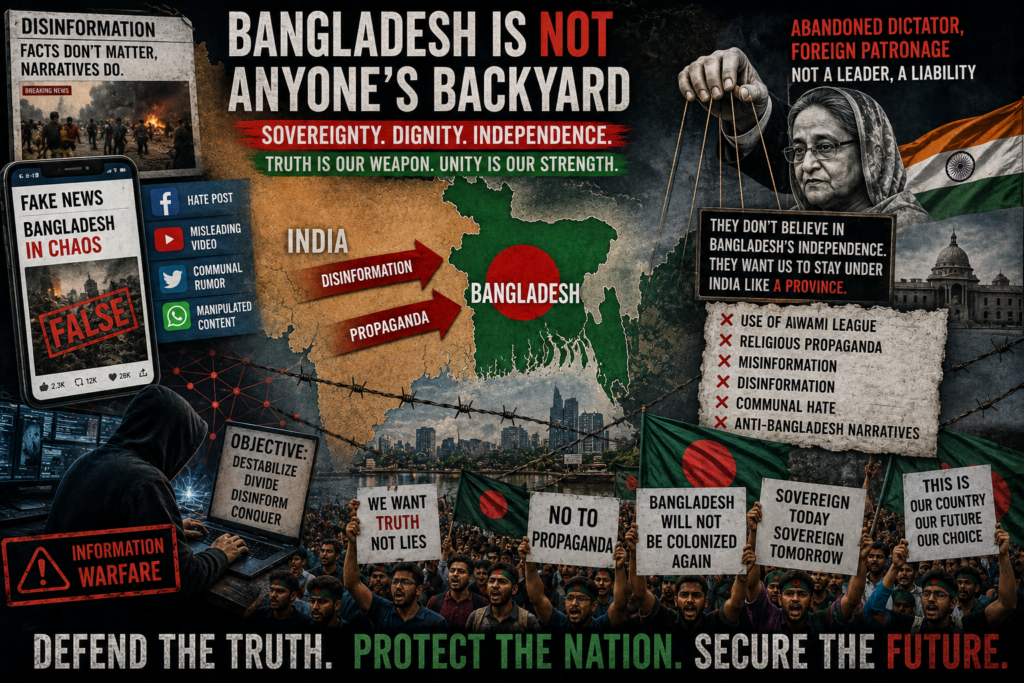
Bangladesh Is Not Anyone’s Backyard: The War Against Disinformation Must Be Won
|
Getting your Trinity Audio player ready...
|
Bangladesh is not anyone’s backyard.
It is not a province. It is not a satellite state. It is not a political playground for defeated leaders, foreign strategists or propaganda factories.
Bangladesh is a sovereign country, born through blood, language, sacrifice and the courage of ordinary people. No foreign media network, no religious propaganda machine and no abandoned authoritarian party has the right to rewrite that dignity.
Yet today Bangladesh is facing a dangerous information war.
It does not always come with tanks or soldiers. It comes through headlines, fake videos, emotional posts, communal rumours, selective outrage and political narratives designed to make Bangladesh look weak, unstable, extremist and incapable of standing on its own feet.
This is not ordinary criticism.
This is disinformation.
Propaganda Is Not Journalism
Journalism asks questions. Propaganda plants poison.
Journalism investigates. Propaganda manipulates.
Journalism checks facts. Propaganda takes one incident, removes context, adds religion, adds fear, adds anger and pushes it into millions of minds before truth can even put on its shoes.
Bangladesh should never be afraid of real journalism. If minorities are attacked, report it. If corruption exists, expose it. If political violence happens, investigate it. If extremists threaten citizens, name them and punish them.
But lies are not journalism.
Half-truths are not journalism.
Religious panic dressed as news is not journalism.
When old videos are sold as new events, when local crimes are turned into national conspiracies, when every Bangladeshi problem is presented as proof that the country cannot survive without a foreign-backed political order, then the goal is not truth.
The goal is control.
The Religious Propaganda Game
One of the ugliest weapons used against Bangladesh is religious propaganda.
The formula is old and dirty.
Take a real social problem. Add communal identity. Remove nuance. Ignore local facts. Push emotional language. Then present Bangladesh as a country where minorities are permanently unsafe and Muslims are collectively guilty.
This is dangerous for everyone.
It harms Bangladesh’s image. It creates suspicion between communities. It also hurts the very minorities it claims to defend, because their real suffering becomes a political tool in someone else’s game.
Bangladesh must protect Hindus, Buddhists, Christians, Indigenous communities, atheists, secular writers and every vulnerable citizen. That is not optional. A state is judged by how it protects those who are most exposed.
But protecting minorities also means protecting truth.
False propaganda does not save minorities. It uses them.
Real attacks must be punished. Fake narratives must be exposed. Both things can be true at the same time.
A mature Bangladesh must say clearly: we will protect every citizen, but we will not allow anyone to use our citizens as weapons against our sovereignty.
India Is Not One Voice
This article is not against ordinary Indian people.
India is a huge country with many voices. Many Indians are democratic, secular, rational and critical of their own propaganda media. Many Indian citizens understand that Bangladesh deserves respect as an independent neighbour.
The problem is not ordinary Indians.
The problem is aggressive nationalist media, political influencers, religious extremists and strategic circles that treat Bangladesh not as a neighbour, but as territory to be managed.
That mentality must be rejected.
Good neighbours do not spread panic about each other. Good neighbours do not use minority issues as political ammunition. Good neighbours do not treat a sovereign country as if it needs permission to choose its own future.
Bangladesh wants friendship with India, but friendship is not submission.
Respect is not dependency.
And sovereignty is not negotiable.
The Awami League Question
Bangladesh cannot fight foreign propaganda honestly while ignoring the domestic forces that benefit from it.
For many Bangladeshis, the fallen Awami League regime became a symbol of authoritarian rule, political arrogance and dangerous dependence on Indian support. Critics believe that parts of its leadership stopped trusting the Bangladeshi people and began relying on foreign protection to survive politically.
That is a serious accusation, but it did not come from nowhere.
When a political party depends more on foreign approval than public trust, it loses its democratic soul. It becomes a client network. It becomes an instrument of influence. It starts treating the country not as a republic of citizens, but as property to be controlled.
Bangladesh was not created for that.
Bangladesh did not fight for independence so that any party could reduce it to a satellite of India. Bangladesh did not bury its martyrs so that defeated politicians could run to foreign narratives and beg for political oxygen.
The harsh truth is simple: any Bangladeshi political force that invites foreign pressure against its own people is standing against the spirit of independence.
This does not mean every Awami League supporter is anti-Bangladesh. Ordinary supporters may believe what they believe for many reasons. They are citizens too. They have rights too.
But the leadership, propaganda networks and loyalist machinery must be judged by their actions, not their slogans.
If a party truly believes in Bangladesh, it must believe in the people of Bangladesh. It must respect public anger. It must accept accountability. It must not use foreign media, communal fear or diplomatic pressure to return to power through the back door.
First Create Fear, Then Offer the Old Regime
The pattern is becoming obvious.
First, Bangladesh is portrayed as collapsing.
Then Bangladesh is portrayed as extremist.
Then Bangladesh is portrayed as unsafe for minorities.
Then the old authoritarian force is presented as the only solution.
This is political blackmail.
It is a strategy of fear.
It tells the world: without the fallen regime, Bangladesh cannot survive. Without the old ruling network, Bangladesh will fall into chaos. Without foreign-backed political management, Bangladesh is not mature enough to govern itself.
This narrative is insulting.
It insults Bangladesh’s people. It insults the students, workers, writers, journalists, activists and ordinary citizens who want a country built on justice instead of fear.
Bangladesh has problems. Serious problems. Political violence, minority insecurity, corruption, religious extremism, weak institutions and online hate must all be confronted honestly.
But those problems must be solved by Bangladeshis through law, reform, accountability and democratic struggle.
Not by foreign propaganda.
Not by Delhi’s pressure.
Not by a fallen dictatorship trying to return through misinformation.
Bangladesh Must Not Be Naive
Modern propaganda is fast.
A lie can cross borders in seconds. A fake video can burn trust overnight. A manipulated headline can create anger before any official statement is written. A religious rumour can turn neighbours into enemies before facts arrive.
That is why Bangladesh must build a stronger information defence.
The country needs faster fact-checking, stronger independent journalism, better digital literacy, responsible government communication and citizens who do not share every emotional post without verification.
Truth must move faster.
Bangladesh also needs courage from its media. Newsrooms must not become party offices. Journalists must not become propaganda workers. Influencers must not sell national dignity for attention.
A country that cannot defend its information space becomes vulnerable to manipulation.
But a country that responds to lies with facts becomes harder to control.
Do Not Hide Real Problems
Bangladesh must also avoid the trap of blind nationalism.
Not every criticism is propaganda. Not every uncomfortable report is an enemy attack. Not every minority concern is foreign conspiracy. Not every human rights criticism is anti-Bangladesh.
If Bangladesh denies real problems, propagandists will become stronger.
If minorities are unsafe, protect them. If extremists threaten people, arrest them. If political criminals attack citizens, punish them. If institutions are weak, rebuild them.
The best answer to propaganda is not shouting.
The best answer is justice.
When Bangladesh protects every citizen equally, foreign narratives lose power. When Bangladesh punishes religious extremists, communal propaganda loses oxygen. When Bangladesh builds trustworthy institutions, misinformation becomes weaker.
National dignity does not come from pretending everything is perfect.
It comes from having the courage to fix what is broken.
Bangladesh Belongs to Its People
The message must be clear.
Bangladesh will not be ruled from Delhi.
Bangladesh will not be frightened by fake news.
Bangladesh will not be handed back to a fallen authoritarian network through religious propaganda.
Bangladesh will not allow any party to trade national dignity for political survival.
Bangladesh belongs to its people.
It belongs to the farmer, the worker, the student, the mother, the writer, the minority citizen, the religious citizen, the non-religious citizen and the young generation that refuses to live under fear.
A sovereign country must defend itself from outside interference.
It must also defend itself from internal collaborators who are willing to weaken the nation for power.
Bangladesh needs friendship with neighbours, not obedience.
It needs truth, not propaganda.
It needs accountability, not dictatorship.
It needs equal citizenship, not communal panic.
It needs confidence, not fear.
Disinformation is a weapon. Religious propaganda is a weapon. Authoritarian nostalgia is a weapon.
Bangladesh must answer all three with facts, justice and national self-respect.
The future of Bangladesh must not be written by foreign media rooms, defeated politicians or online propaganda armies.
It must be written by Bangladeshis.
And it must be written in freedom.