
Bangladesh
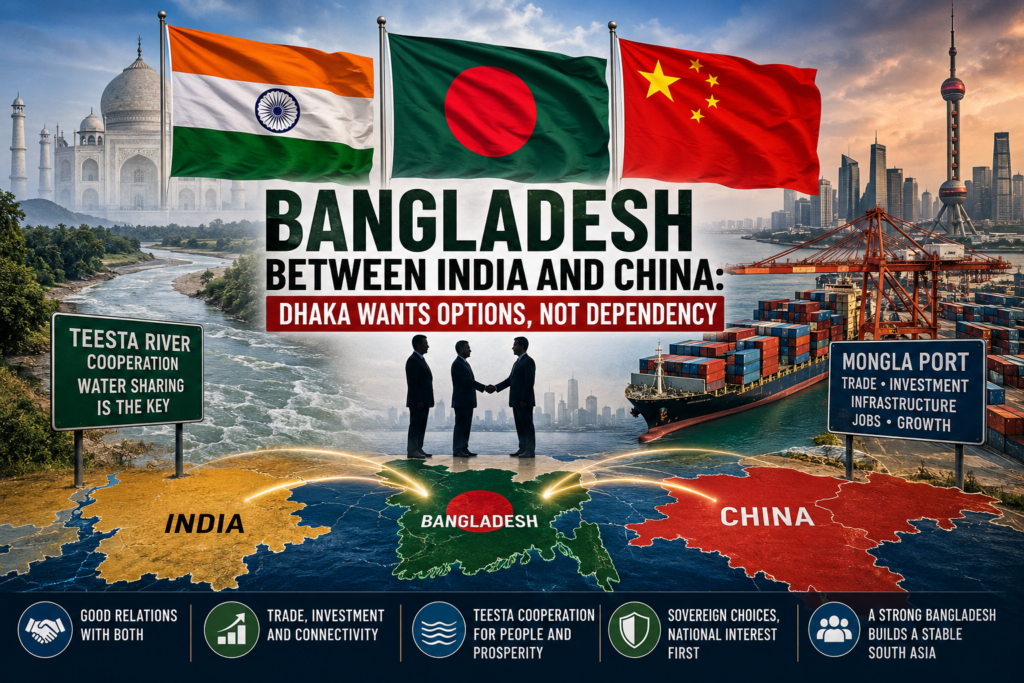
Bangladesh Between India and China: Dhaka Wants Options, Not Dependency
|
Getting your Trinity Audio player ready...
|
Bangladesh is entering a delicate moment in South Asian diplomacy.
Its relationship with China is growing more visible. India is watching closely. And Dhaka is trying to do something that every sovereign country should be allowed to do: create options.
That is the heart of the story.
Bangladesh does not want to be trapped inside one relationship. It does not want its economy, rivers, ports or foreign policy to depend on one neighbour’s mood. It wants investment from China, workable ties with India, access to Western markets, labour opportunities abroad and enough diplomatic space to protect its own interests.
That is not betrayal.
That is foreign policy.
China Visit Changes the Conversation
Bangladesh’s latest engagement with China has moved beyond polite diplomacy.
During Prime Minister Tarique Rahman’s China visit, Dhaka urged Beijing to reduce the large trade gap, buy more Bangladeshi goods and speed up important infrastructure projects. Reuters reported that Bangladesh pushed China to import more products such as fruits, aquatic goods, leather and pharmaceuticals, while both sides discussed ports, water and river projects, including Teesta. (Reuters)
This matters because Bangladesh’s relationship with China has often looked one-sided.
Bangladesh imports heavily from China. It depends on Chinese machinery, industrial materials, electronics and project financing. But Bangladeshi exports to China remain far smaller. That imbalance cannot be ignored forever.
A serious partnership must work both ways.
If China wants deeper influence in Bangladesh, it should also open its market more seriously to Bangladeshi goods.
Friendship cannot be measured only by loans and ribbon-cutting ceremonies.
It must also be measured by trade fairness.
India Is Watching the Ports
India’s concern is not difficult to understand.
Bangladesh sits in a strategic position near the Bay of Bengal. Its ports, rivers, roads and industrial zones matter not only to Bangladesh, but also to the wider regional balance. When China becomes more active around Bangladeshi ports or economic zones, New Delhi sees more than development. It sees strategy.
Indian media reported that China is expanding its footprint through a deal linked to an economic zone near Mongla port, Bangladesh’s second-largest seaport. The report said the land involved had earlier been connected to an Indian-backed project before being redirected. (The Times of India)
That is why Mongla is now more than a port story.
It is about trade, logistics, influence and the future of the Bay of Bengal.
For Bangladesh, however, the question should not be whether India is happy or China is happy. The question should be whether Bangladesh benefits.
Will Mongla create jobs?
Will it increase exports?
Will it improve logistics?
Will the terms be transparent?
Will Bangladesh control the strategic direction of the project?
Those are the questions that matter.
Teesta Is Still the Emotional Centre
No issue shows Bangladesh’s difficult position better than Teesta.
For people in northern Bangladesh, Teesta is not a diplomatic file. It is water, farming, erosion, livelihood and survival. When the river becomes trapped in regional politics, ordinary people pay the price.
Bangladesh and China have agreed to deepen cooperation on Teesta river management, according to reporting on Rahman’s Beijing visit. (The Times of India) But the issue remains sensitive because India has long been central to Teesta water-sharing discussions.
This is where Bangladesh’s frustration becomes understandable.
If one route remains blocked for years, Dhaka will naturally look for alternatives.
That does not mean Bangladesh should turn Teesta into an anti-India weapon. It should not. Water security is too serious for political theatre.
But India also needs to understand that delay creates space for others. When Bangladesh waits too long for a fair outcome, it will search for new partners.
That is not surprising.
It is predictable.
Bangladesh Must Not Become a Client State
The danger for Bangladesh is not China alone or India alone.
The danger is dependency.
A country can become dependent on India through geography, politics and border pressure. It can become dependent on China through loans, infrastructure and strategic projects. It can become dependent on the West through trade access, labour standards and financial systems.
The task of serious leadership is to avoid all forms of dependency.
Bangladesh should work with India because India is its unavoidable neighbour.
Bangladesh should work with China because China has money, technology, industrial capacity and diplomatic weight.
Bangladesh should work with the West because exports, labour rights, investment and global legitimacy matter.
But Bangladesh should kneel before none of them.
That is the line.
India Must Respect Bangladesh’s Sovereignty
India has legitimate security concerns. No serious analyst should deny that.
But legitimate concern does not give India the right to treat Bangladesh as a backyard. Bangladesh is not a buffer zone. It is not a political extension of New Delhi. It is an independent republic with its own voters, workers, rivers, ports and national interest.
If India wants trust in Bangladesh, it must build that trust through respect.
Respect means fair water-sharing.
Respect means border restraint.
Respect means not using Bangladesh’s internal politics as a playground.
Respect means understanding that Dhaka has the right to make economic choices without being treated as disloyal.
Good neighbours do not demand obedience.
They earn confidence.
China Must Also Be Tested
Bangladesh should be equally careful with China.
Chinese investment can help Bangladesh, but only if the terms are transparent and productive. Infrastructure projects can transform an economy, but bad loans and weak contracts can become a burden.
Bangladesh must ask hard questions.
Who benefits?
Who pays?
What are the loan terms?
How many jobs will be created?
Will technology be transferred?
Will local businesses gain?
Will the project strengthen Bangladesh, or only expand another power’s influence?
China will protect China’s interest. That is normal.
Bangladesh must protect Bangladesh’s interest with the same seriousness.
The Bay of Bengal Is Becoming More Important
The wider story is the Bay of Bengal.
This region is no longer quiet. It sits between South Asia and Southeast Asia. It connects trade routes, energy routes, military interests and port networks. India, China, Japan, the United States and others all understand its importance.
Bangladesh sits at the centre of that geography.
That gives Dhaka opportunity.
It also gives Dhaka risk.
If Bangladesh plays carefully, it can attract investment, strengthen ports, improve trade and become a more important regional economy. If it plays carelessly, it can become trapped in other countries’ rivalries.
The difference will be discipline.
Ordinary Bangladeshis Must Benefit
Foreign policy should not be judged by photographs of leaders shaking hands.
It should be judged by results.
Will farmers around Teesta receive better river management?
Will Mongla and other ports create jobs?
Will Chinese markets buy more Bangladeshi goods?
Will India improve trust through fairer cooperation?
Will Bangladesh avoid debt pressure?
Will ordinary citizens feel any benefit?
If the answer is no, then the diplomacy is only theatre.
Bangladesh does not need theatre.
It needs delivery.
The Real Lesson
Bangladesh is not choosing between India and China.
Bangladesh is choosing whether it can act like a confident country.
That means keeping friendship with India without accepting dominance. It means accepting Chinese investment without surrendering strategic control. It means working with every major power while remembering that the first duty of Dhaka is to Bangladeshis.
The phrase should be simple:
Bangladesh first.
Not India first.
Not China first.
Not any party first.
Bangladesh first.
That is not nationalism without logic. It is the basic rule of sovereignty.
A mature Bangladesh should keep many doors open, but it must keep the keys in its own hands.