
Analysis
Bangladesh’s Measles Crisis Is a Warning That No Child Should Be Left Unprotected
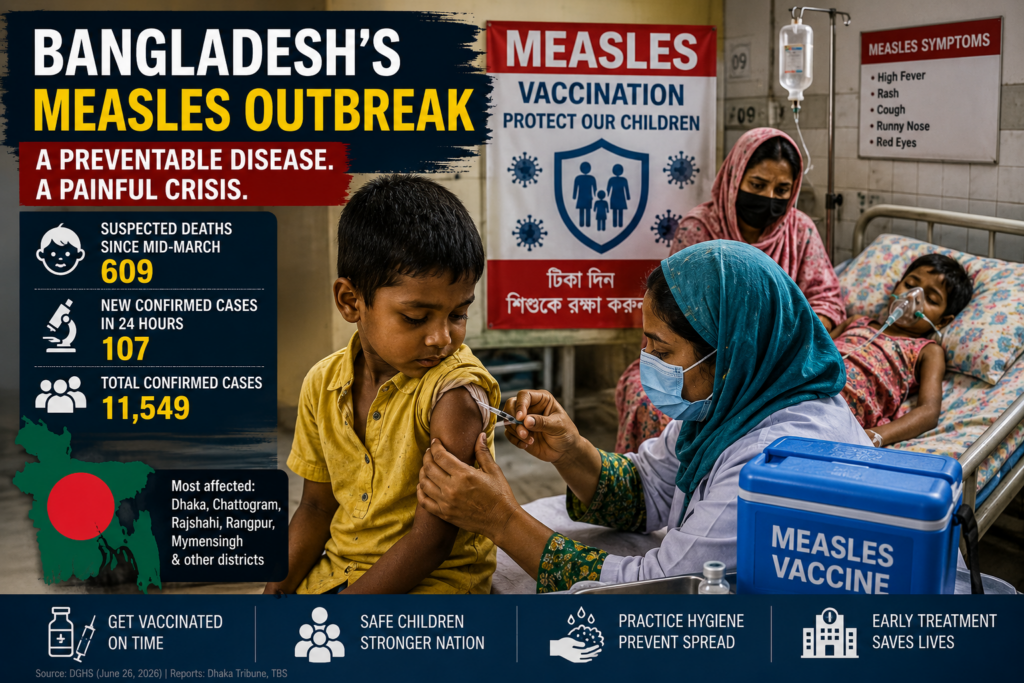
|
Getting your Trinity Audio player ready...
|
Bangladesh is facing a public-health warning that should make the whole country stop and listen.
Four more children have died in 24 hours with suspected measles symptoms, pushing the suspected death toll since mid-March to 609, according to health authority figures reported by local media. During the same period, more than 100 new cases were laboratory confirmed.
These are not just numbers.
They are children.
They are families.
They are hospital beds, frightened parents, exhausted doctors and communities asking why a preventable disease is still taking young lives in 2026.
Measles is not a mysterious illness. It is one of the most contagious diseases in the world, but it is also one of the most preventable. When vaccination coverage is strong, measles can be controlled. When gaps appear, the virus finds the children left behind.
That is what makes this crisis so painful.
A Preventable Disease Is Killing Children
Every child death from a vaccine-preventable disease should be treated as a national failure.
Not because doctors are not trying. Not because parents do not care. But because a health system is supposed to protect children before they reach the emergency ward.
Measles spreads fast. One infected child can expose many others, especially in crowded homes, schools, hospitals and low-income neighbourhoods. Children who are too young, undernourished or not fully vaccinated face the greatest danger.
This is why vaccination is not only a personal choice. It is public protection.
When enough children are vaccinated, the whole community becomes safer. When coverage falls, even small gaps can become dangerous.
Bangladesh is now seeing what happens when those gaps become too wide.
Parents Need Trust, Not Confusion
A successful vaccination campaign depends on trust.
Parents must know where to go. They must know the vaccine is available. They must believe the system is safe, organised and honest. They must receive clear information before rumours and fear take over.
In Bangladesh, misinformation can spread quickly. Some parents may delay vaccination because of fear, confusion, poverty, lack of transport or poor access to health centres. Others may not understand how dangerous measles can become until it is too late.
The government cannot simply blame parents.
It must reach them.
Public-health messages must be simple, repeated and local. Health workers need support. Community leaders, schools, mosques, local clinics and media outlets should all be part of the response.
A child should not die because information arrived too late.
Hospitals Are Carrying the Pressure
When outbreaks grow, hospitals feel the pressure first.
Doctors and nurses are forced to handle more patients, more anxious families and more severe cases. In a country where public hospitals are already crowded, a measles surge can quickly expose weaknesses in beds, oxygen, isolation space, medicine and staffing.
This is not only about measles.
It is about the strength of the health system.
A country can build bridges, roads and towers, but if children die from preventable disease, development loses its moral meaning. Public health is not a side issue. It is the foundation of national security.
A strong country protects its children.
Bangladesh Needs an Honest Review
This crisis demands more than emergency statements.
Bangladesh needs an honest review of what went wrong.
Were vaccines available everywhere?
Were routine immunisation programmes disrupted?
Were high-risk districts identified early enough?
Were parents properly informed?
Were hospitals prepared?
Were local health workers given enough resources?
These questions should not be treated as political attacks. They are necessary if the country wants to stop the next outbreak before it becomes another tragedy.
Accountability saves lives when it leads to better systems.
Silence does not.
The Poor Suffer First
Disease does not hit every family equally.
A wealthy family can often reach private doctors faster. They can afford transport, tests, medicine and better follow-up care. A poor family may wait, borrow money, visit local medicine sellers first, or reach the hospital only when the child is already very sick.
That is why outbreaks expose inequality.
The poorest children are often the most vulnerable. They may live in crowded housing. They may have weaker nutrition. Their parents may have less access to reliable health information. Their local clinics may be under-resourced.
If Bangladesh wants to protect children, it must protect the poorest children first.
That is where public health must begin.
Vaccination Must Become a National Priority Again
Bangladesh has made major progress in child immunisation over the decades. That progress should not be forgotten. But progress can be lost if systems become weak, supplies are delayed, campaigns are disrupted or public trust declines.
Measles does not forgive delay.
The response must be aggressive and organised. Vaccination drives must reach every high-risk area. Health workers must go door to door where necessary. Schools and community centres should become information points. Hospitals must be ready for complications.
The goal should be clear: no child should be missed because of poverty, location or confusion.
The Real Lesson
Bangladesh does not need panic.
It needs urgency.
A public-health crisis is not solved by fear. It is solved by clear information, strong vaccination, hospital readiness, honest leadership and local-level action.
The measles outbreak is a warning that child health cannot be treated casually. It shows how quickly a preventable disease can return when protection weakens. It also shows why public trust, routine immunisation and basic healthcare matter as much as any large national project.
A country’s future is not only measured by GDP, foreign investment or infrastructure.
It is measured by whether children survive illnesses that medicine already knows how to prevent.
Bangladesh must treat this outbreak as a turning point.
Not tomorrow.
Now.