
Bangladesh
Dhaka Looks to Beijing as Bangladesh Pushes for Jobs, Investment and Teesta Progress
|
Getting your Trinity Audio player ready...
|
Dhaka is looking to Beijing at a time when Bangladesh needs more than diplomatic smiles and official photographs.
It needs investment. It needs jobs. It needs stronger infrastructure. It needs progress on Teesta. And above all, it needs foreign policy that produces results for ordinary people.
That is why the latest Bangladesh-China talks matter.
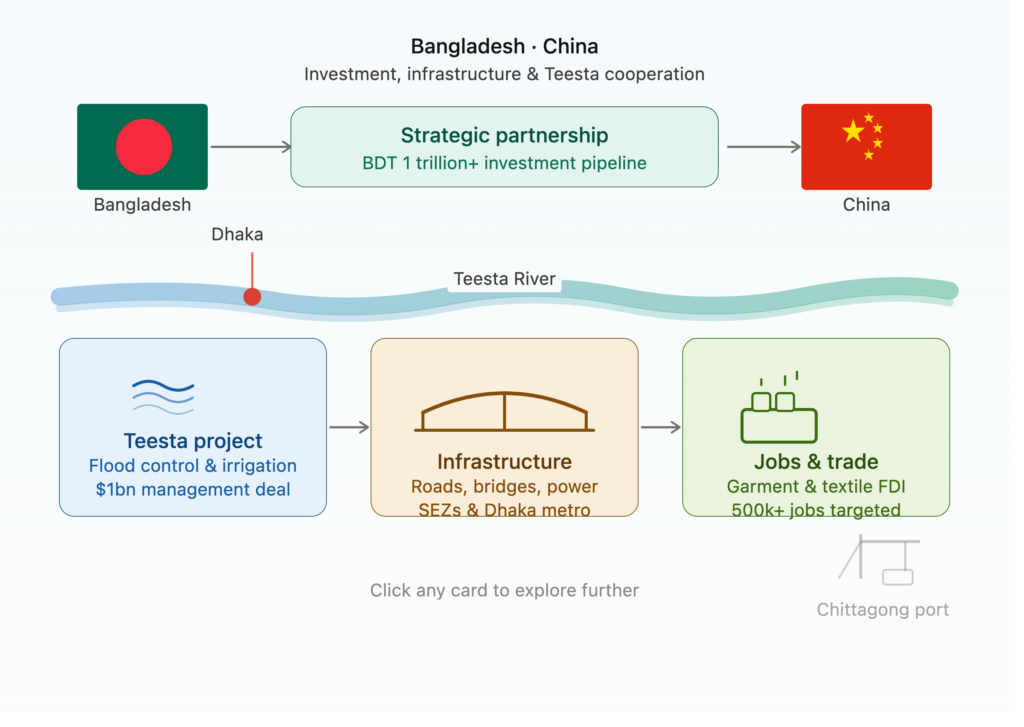
Bangladesh and China are expected to sign a series of bilateral instruments during high-level talks between Prime Minister Tarique Rahman and Chinese Premier Li Qiang in Beijing. BSS reported that 15 memorandums of understanding are expected to be signed in the presence of the two leaders, while earlier briefings suggested the package could include MoUs, agreements, an action plan and a protocol. (BSS)
This is not just another foreign visit. It is a test of whether Dhaka can turn diplomacy into jobs, investment and practical national gains.
A Visit About Money, Work and Influence
Rahman’s first overseas tour has carried a clear economic message.
Reuters reported that his trip to Malaysia and China is aimed at attracting investment, boosting overseas employment and signalling Bangladesh’s foreign-policy priorities. The China leg is especially important because Beijing is already one of Dhaka’s major development financiers and trading partners. (Reuters)
For Bangladesh, the timing is important.
The country needs foreign capital, industrial growth and employment opportunities. Young people are entering the job market. Export industries need expansion. Ports, roads, logistics and energy systems need upgrading. Families are under pressure from living costs.
So the question is not whether Bangladesh should seek investment.
The question is whether it can negotiate smart investment.
Investment Must Create Real Jobs
One major project already shows the scale of what is at stake.
Reuters reported that Bangladesh recently approved a 41.89 billion taka, or about $340 million, infrastructure project for the Chinese Economic and Industrial Zone in Chittagong. The project is backed by 24.67 billion taka in concessional Chinese loans and is expected to create around 100,000 jobs while attracting more than $500 million in foreign direct investment in its initial phase. (Reuters)
Those numbers matter.
But numbers alone do not change lives. A project becomes meaningful only when it creates real jobs, transfers skills, supports local suppliers and strengthens Bangladesh’s production capacity.
Bangladesh should welcome factories, technology and infrastructure. But it must also ask hard questions.
Who gets the jobs?
What skills will Bangladeshi workers learn?
Will local businesses benefit?
Are the loan terms safe?
Will the project serve the public, or only contractors and political insiders?
A good deal can strengthen the country.
A bad deal can become a burden for years.
Teesta Is Not Just a River
Teesta is one of the most sensitive issues in Bangladesh’s regional diplomacy.
For northern Bangladesh, Teesta is not just a line on a map. It is water for farmers, security for families and survival for local communities. When river flow becomes uncertain, agriculture suffers. When river management fails, land, homes and livelihoods become unstable.
That is why Teesta has become more than a water issue. It is a national dignity issue.
Bangladesh and China have agreed to deepen cooperation on Teesta and other river-management issues during Rahman’s Beijing visit, according to reporting on the meeting with China’s Water Resources Minister Li Guoying. (The Times of India)
Bangladesh had already formally sought China’s involvement and support for the Teesta River Comprehensive Management and Restoration Project in May, according to BSS reporting. (BSS)
This is politically important because the long-delayed Teesta water-sharing issue with India has frustrated Bangladesh for years. If one door remains blocked, Dhaka has every right to explore another.
But Teesta should not become a geopolitical trophy.
It must be handled as a people’s project, with transparency, environmental care and direct benefit for the communities who depend on the river.
Dhaka Wants More Diplomatic Space
The visit also sends a wider message.
Bangladesh does not want to be trapped between bigger powers. It wants room to move.
Reuters noted that ties with India have improved somewhat since Rahman’s government took office, but tensions remain over issues such as border problems and alleged migrant push-ins. The report also quoted a University of Dhaka academic saying China is crucial for investment, while Malaysia remains key for overseas employment. (Reuters)
That is the reality of Bangladesh’s foreign policy.
India is the neighbour Bangladesh cannot ignore. China is the investor Bangladesh cannot ignore. Malaysia and the Gulf matter because of labour migration. The West matters for trade, sanctions risk, democracy pressure and markets.
Dhaka’s challenge is to work with all sides without becoming dependent on any side.
Good relations with India are necessary.
Strong relations with China can be useful.
Partnerships with Malaysia, the Gulf, Europe and the United States are also important.
But friendship must never mean surrender.
Green Energy and Electric Vehicles Could Be Next
The China talks are not only about old-style infrastructure.
Bangladesh is also expected to seek Chinese investment and technology transfer in renewable energy and electric vehicle manufacturing, according to local business reporting ahead of the visit. (The Business Standard)
That could become important for the future.
Bangladesh needs cleaner energy, lower import pressure and new industrial sectors. Electric vehicles, batteries, solar equipment and green manufacturing could create jobs if handled properly.
But again, the same rule applies: Bangladesh must not become only a market for foreign products.
It should seek factories, training, technology transfer and local value creation.
The goal should be to build Bangladeshi capacity, not just import someone else’s machines.
Migrant Workers Are Part of the Story
Rahman’s wider trip also included Malaysia, and that matters for Dhaka.
Bangladeshi migrant workers are one of the country’s economic pillars. Their remittances support families, strengthen foreign reserves and keep rural economies moving.
But too many migrant workers face recruitment debt, exploitation and weak protection abroad.
So when Bangladesh talks to Malaysia or China, the subject should not only be elite investment. It should also be ordinary workers. Better recruitment systems, safer labour migration, fairer contracts and worker welfare must be central to foreign policy.
A government visit is not successful if only ministers and businessmen benefit.
It is successful when workers benefit too.
The Risk of Dependency
Bangladesh should be confident, but not careless.
China is a powerful country. It invests with strategic purpose. It does not spend money out of charity. Like every major power, it protects its own interest.
That is normal.
So Bangladesh must protect its own interest too.
It should avoid hidden contracts, politically motivated loans and projects that damage the environment or create debt pressure. It should publish details, strengthen oversight and make sure parliament, media and experts can examine major agreements.
Foreign investment is not dangerous by itself.
Blind dependency is dangerous.
Bangladesh must bargain like a country that knows its value.
The Real Test Begins After the Signing
The signing ceremony will make headlines.
But the real test begins after the papers are signed.
Will the MoUs turn into real projects?
Will investment actually arrive?
Will jobs be created?
Will Teesta cooperation move from discussion to delivery?
Will Bangladesh keep control over its own decisions?
Will ordinary people feel any benefit?
These are the questions that matter.
Bangladesh has seen enough political theatre. People want delivery. Farmers want water. Young people want work. Workers abroad want protection. Businesses want stability. Citizens want leaders who negotiate with intelligence, not emotion.
Dhaka should use Beijing’s interest carefully.
It should welcome partnership, but reject control.
It should seek investment, but avoid dependency.
It should build friendship, but defend sovereignty.
Bangladesh’s future will not be built by waiting for others to solve its problems.
It will be built by smart deals, honest leadership and a foreign policy that puts Bangladeshi citizens first.