
Bangladesh
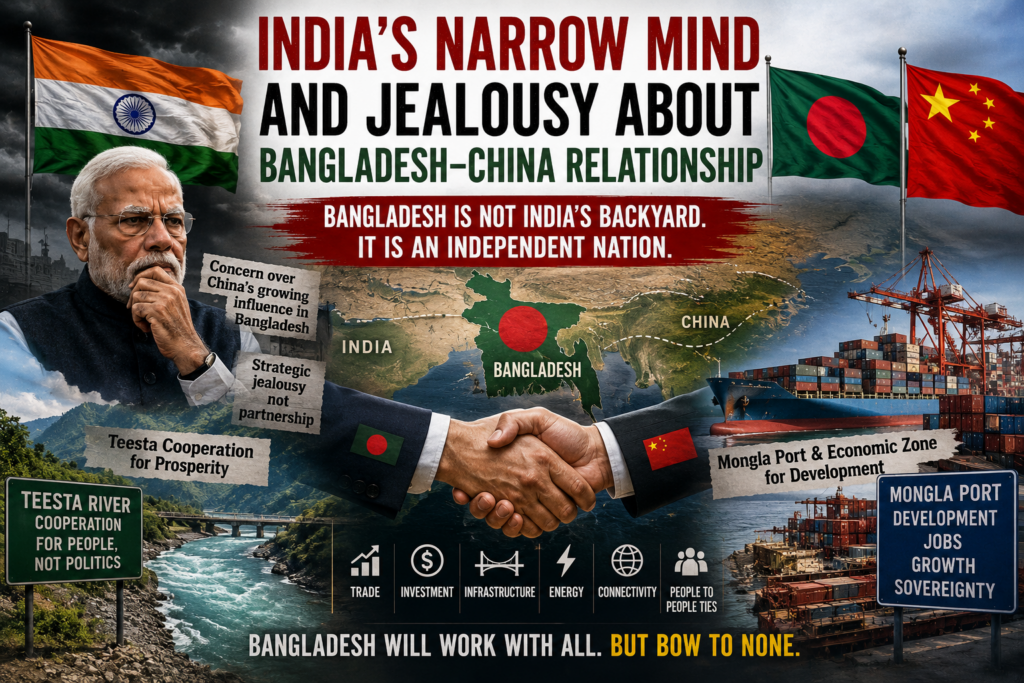
India Must Stop Treating Bangladesh’s China Ties as a Threat
|
Getting your Trinity Audio player ready...
|
India needs to understand something very clearly: Bangladesh is not a subordinate state.
It is not a backyard. It is not a buffer zone. It is not a political extension of New Delhi. It is an independent country with its own people, rivers, ports, economy, security concerns and national interest.
So when Bangladesh builds stronger ties with China, India may watch carefully. It may analyse. It may raise legitimate security questions. But it has no moral right to behave as if Dhaka has committed a crime by seeking options.
Bangladesh’s relationship with China is not betrayal.
It is foreign policy.
India’s Discomfort Reveals a Bigger Problem
New Delhi’s unease over Bangladesh-China cooperation is not new. It becomes louder whenever Dhaka explores Chinese support for ports, infrastructure, river management or industrial projects.
The latest China visit has only sharpened that discomfort.
Reuters reported that Bangladesh urged China to reduce the trade gap, buy more Bangladeshi goods and speed up key infrastructure projects during Prime Minister Tarique Rahman’s talks in Beijing. Dhaka also sought greater Chinese imports of fruits, aquatic products, leather and pharmaceuticals, while both sides discussed cooperation on ports, water and river projects, including Teesta. (Reuters)
This is not an anti-India agenda.
This is Bangladesh trying to solve Bangladesh’s problems.
The problem is that India too often reads Bangladesh’s independent choices through the lens of its own insecurity. If Dhaka talks to Beijing, some Indian voices panic. If Bangladesh discusses Teesta with China, they call it a strategic warning. If Bangladesh explores port development, they see encirclement.
That reaction says more about India’s mindset than Bangladesh’s intentions.
A Mature Power Does Not Fear Its Neighbour’s Choices
A confident India would ask a simple question: why is Bangladesh looking elsewhere?
The answer is not difficult.
Bangladesh has waited years for fair progress on Teesta. It has faced repeated frustration over water-sharing. It has heard warm words but received limited delivery. Its exporters need access. Its infrastructure needs investment. Its workers need jobs. Its ports need modernisation.
If India leaves gaps, others will fill them.
That is not conspiracy.
That is geography meeting economics.
India cannot delay Bangladesh’s needs and then act offended when Bangladesh searches for alternatives. A relationship built on respect must accept that Dhaka has the right to choose partners based on national benefit.
Friendship cannot mean Bangladesh must wait forever.
Friendship cannot mean India decides which door Dhaka is allowed to open.
Teesta Is Not India’s Private File
Teesta is one of the clearest examples of why Bangladesh needs wider options.
For people in northern Bangladesh, Teesta is not a diplomatic talking point. It is water. It is farming. It is irrigation. It is erosion. It is livelihood. It is survival.
When the issue remains unresolved for years, ordinary Bangladeshis pay the price.
Reports from India said Bangladesh and China agreed to deepen cooperation on Teesta river management during Rahman’s Beijing visit. (The Times of India) That naturally makes India nervous, because Teesta has long sat at the centre of Bangladesh-India water politics.
But India should ask itself a harder question.
Why did Bangladesh need to look to China on Teesta at all?
If New Delhi wants to remain Dhaka’s most trusted neighbour, it must deliver on issues that matter to Bangladeshis. Not with speeches. Not with symbolic friendship. With action.
Water cannot be handled with ego.
Water requires fairness.
Mongla Shows the Strategic Reality
Mongla port is another sensitive point.
Indian media reported that China is expanding its footprint through a deal linked to an economic zone near Mongla port, Bangladesh’s second-largest seaport, on land earlier connected to an Indian-backed project. (The Times of India)
India sees this through a strategic lens. That is expected. Ports matter. The Bay of Bengal matters. Trade routes matter. China’s footprint in the Indian Ocean matters.
But again, Bangladesh must ask the only question that matters: does this project serve Bangladesh?
Will it create jobs?
Will it improve logistics?
Will it strengthen exports?
Will it benefit local communities?
Will it remain under Bangladeshi control?
If the answer is yes, Bangladesh has every right to proceed carefully and confidently.
India’s discomfort cannot be the final measure of Bangladesh’s development.
Bangladesh Must Not Replace One Dependency With Another
A strong article must be honest on both sides.
Bangladesh should not become dependent on China either.
Chinese investment can be useful, but it must never become a chain. Loans must be transparent. Projects must be productive. Contracts must protect Bangladesh’s sovereignty. No port, river project or economic zone should become a tool for foreign leverage.
China will protect China’s interest. India protects India’s interest. Every serious country does this.
Bangladesh must do the same.
The point is not to choose Beijing over New Delhi.
The point is to make sure Bangladesh does not kneel before either.
India’s Narrow Thinking Can Damage Its Own Influence
If India treats every Bangladesh-China engagement as betrayal, it will push Bangladesh further away.
That is the irony New Delhi often fails to see.
Pressure does not build trust. Patronising language does not build friendship. Media panic does not build respect. Treating Bangladesh as a junior partner does not create loyalty. It creates resentment.
India’s best strategy is not to scold Bangladesh.
It is to become a better partner.
Resolve water disputes fairly. Respect Bangladesh’s political independence. Stop seeing every Bangladeshi decision as a test of loyalty. Offer investment that competes with China. Treat Dhaka as a sovereign capital, not a regional branch office.
That is how influence is earned.
Not through jealousy.
Not through suspicion.
Not through strategic arrogance.
Bangladesh Needs a Many-Door Foreign Policy
Bangladesh’s future cannot depend on one country.
It needs India for geography, trade, connectivity and regional stability.
It needs China for investment, infrastructure, technology and industrial growth.
It needs the West for export markets, labour standards, education and global legitimacy.
It needs Malaysia and the Gulf for labour opportunities and remittances.
A country with only one door can be trapped.
A country with many doors can negotiate.
That is why Bangladesh must keep a many-door foreign policy. It should work with everyone, but allow no one to own its future.
Sovereignty Means Making Others Uncomfortable Sometimes
A truly sovereign country will sometimes make powerful neighbours uncomfortable.
That is normal.
Sovereignty is not proven by pleasing everyone. It is proven by making decisions based on national interest, even when others complain.
Bangladesh must be calm, not reckless.
It must be balanced, not submissive.
It must be open to China, but not captured by China.
It must maintain relations with India, but not be managed by India.
The guiding principle should be simple: Bangladesh first.
Not India first.
Not China first.
Not any foreign capital first.
Bangladesh first.
The Real Lesson
India should not fear Bangladesh’s China ties. It should learn from them.
If Bangladesh is turning to China for trade access, infrastructure, Teesta cooperation and investment, that is not because Bangladesh hates India. It is because Bangladesh has needs that must be met.
A mature India would respond with better partnership.
A narrow-minded India responds with suspicion.
Bangladesh must not be intimidated by that suspicion.
The country has the right to build ports, manage rivers, seek investment, expand exports and shape its diplomacy according to its own interest.
New Delhi must accept a simple truth: Bangladesh is no longer willing to live inside anyone’s shadow.
It wants friendship.
It wants options.
It wants respect.
And it has every right to demand all three.