
Analysis
India’s Hindu Nationalist Politics Is Turning Faith Into a Weapon
|
Getting your Trinity Audio player ready...
|
India’s problem is not Hinduism.
India’s problem is what political extremists are doing in the name of Hinduism.
There is a difference, and it matters.
Hinduism is a vast religious and cultural tradition with millions of ordinary believers who want to live peacefully. But Hindutva politics is something else. It is a hard nationalist project that uses religion as identity, power and pressure. It turns faith into a political weapon. It treats Muslims as suspects. It treats criticism as insult. It treats Bangladesh as a convenient target whenever nationalist emotion needs fuel.
That is dangerous for India.
It is dangerous for Bangladesh.
And it is dangerous for South Asia.
Faith Should Not Become a Weapon
Religion becomes poisonous when political power uses it to divide citizens.
A temple should not become a symbol of revenge.
A mosque should not become a target.
A border should not become a stage for humiliating poor people.
A minority community should not be forced to prove loyalty every day.
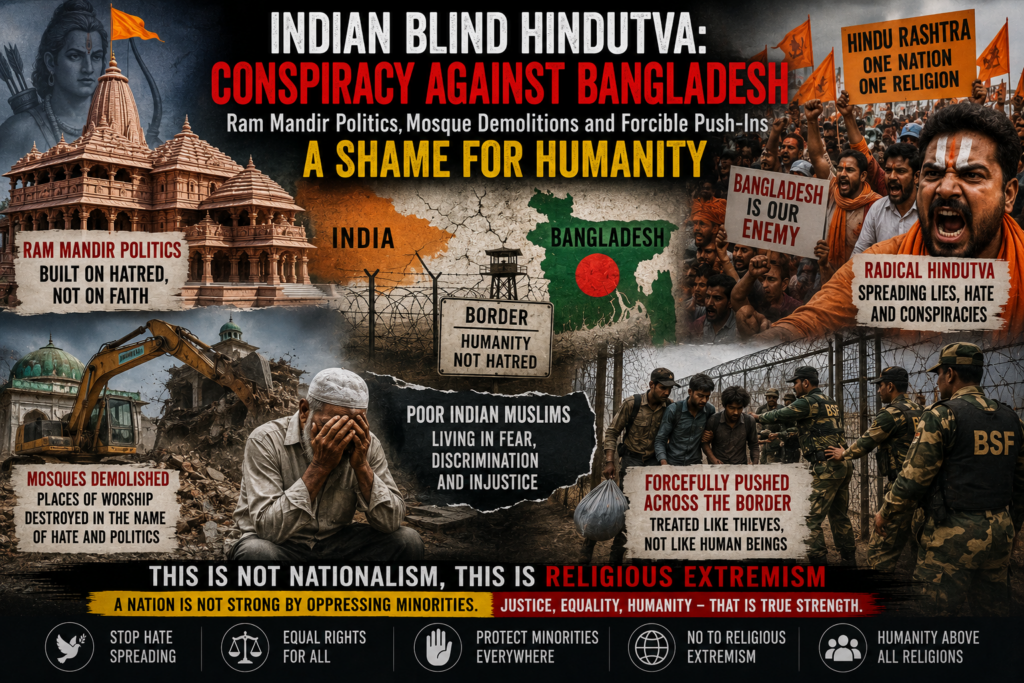
Yet this is the reality many Indian Muslims now fear. They are citizens of India, but too often they are treated as outsiders inside their own country. Their homes, mosques, businesses, names, food habits and political voices are pulled into a permanent test of belonging.
That is not democracy.
That is majoritarian pressure.
A country does not become strong by frightening its minorities. It becomes morally weaker.
The Shadow of Babri Masjid Still Remains
The Ram Mandir in Ayodhya cannot be discussed honestly without remembering what stood there before.
The Babri Masjid was demolished in 1992 by Hindu nationalist mobs, an event that scarred Indian politics and deepened Hindu-Muslim division for generations. In 2019, India’s Supreme Court allowed the disputed land to be used for the Ram temple, while also recognising that the demolition of the mosque was a violation of law.
That contradiction still sits at the heart of the issue.
A mosque was destroyed unlawfully.
A temple was later built on the disputed site.
Millions celebrated it as religious pride.
But for many Muslims, it remains a painful symbol of loss, humiliation and unequal justice.
A mature society must be able to say this clearly: faith cannot be built on the rubble of another community’s dignity.
Anti-Muslim Politics Has Become Too Normal
The problem is not only Ayodhya.
Human rights groups have repeatedly raised concerns about the treatment of Muslims in India. Amnesty International has criticised the unlawful demolition of Muslim homes, businesses and places of worship, describing the use of bulldozers as a tool of punishment and intimidation. Human Rights Watch has also warned that vilification of Muslims and government critics has increased under Hindu nationalist politics.
This is not the language of healthy democracy.
When houses are demolished after communal tension, when Muslim neighbourhoods are targeted, when activists are arrested, when journalists face pressure, when political leaders use religious identity to win votes, the message becomes clear.
Muslims are not being treated only as citizens.
They are being treated as a political problem.
That is shameful for a country that calls itself the world’s largest democracy.
Border Push-Ins Are a Human Rights Issue
India’s treatment of Bengali-speaking Muslims near the Bangladesh border has created another serious concern.
Bangladesh has accused Indian authorities of trying to force people across the border. Reuters reported that Bangladesh strengthened border vigilance after suspected forced crossings from India, and later reported that Bangladesh said it had foiled multiple attempts by Indian authorities to push people into Bangladeshi territory.
If people are genuinely Bangladeshi nationals, there must be a legal and diplomatic process.
But forcing poor people toward a border like unwanted cargo is not justice. It is cruelty.
No human being should be treated like a thief simply because of language, poverty, religion or appearance. Indian Muslims, Bengali-speaking residents, Rohingya refugees and undocumented people all deserve due process. Their nationality must be verified through law, not decided by political anger.
A state that humiliates the poor at the border is not showing strength.
It is showing moral failure.
Bangladesh Must Not Accept Religious Propaganda
Bangladesh should be very clear.
It must not accept India’s religious propaganda.
It must not accept forced push-ins.
It must not accept border humiliation.
It must not accept narratives that portray Bangladesh as a dumping ground for people India does not want.
Bangladesh is a sovereign country. It has the right to demand legal verification, formal repatriation procedures and respect for human dignity.
At the same time, Bangladesh must not answer Hindu nationalist extremism with anti-Hindu hatred.
That would be a trap.
Bangladesh must protect Hindus, Muslims, Buddhists, Christians, atheists and every citizen equally. That is the difference between a confident state and a communal state.
The answer to Hindutva extremism is not Muslim extremism.
The answer is secular justice, equal citizenship and strong national dignity.
Radical Nationalism Damages India Too
Hindutva politics may create short-term electoral power, but it damages India’s long-term social fabric.
India is not a Hindu-only civilisation. It is home to Muslims, Christians, Sikhs, Buddhists, Jains, atheists, Dalits, tribal communities, linguistic minorities and countless regional identities. Its strength has always come from complexity.
But radical nationalism hates complexity.
It wants one story.
One identity.
One loyalty test.
One enemy.
That is why Muslims become useful targets. Bangladesh becomes a useful suspicion. Pakistan becomes a permanent ghost. China becomes a strategic fear. Any internal criticism becomes anti-national.
This is not confidence.
It is insecurity dressed as power.
Bangladesh Should Speak With Moral Clarity
Bangladesh does not need to shout. It needs to speak clearly.
It should say that India’s internal communal politics must not spill over into Bangladesh.
It should say that any border repatriation must follow law.
It should say that Bengali-speaking Muslims cannot be pushed into Bangladesh without proof.
It should say that mosque demolitions and anti-Muslim intimidation are not signs of civilisation.
It should say that South Asia needs peace, not religious revenge.
Bangladesh must also look at itself. It cannot criticise India’s treatment of Muslims while ignoring attacks on minorities at home. It cannot speak for justice abroad while allowing religious intimidation inside Bangladesh.
Moral clarity must begin at home.
But that does not mean Bangladesh should stay silent about India.
A neighbour’s injustice can become a regional problem.
The Real Battle Is Not Hindu Versus Muslim
This is not a religious battle between Hindus and Muslims.
That is exactly the language extremists want.
The real battle is between equal citizenship and majoritarian domination.
It is between truth and propaganda.
It is between secular law and religious revenge.
It is between human dignity and political cruelty.
Ordinary Hindus are not the enemy. Ordinary Muslims are not the enemy. Ordinary Indians and Bangladeshis are not the enemy.
The enemy is extremist politics that turns faith into a weapon and then asks the poor to pay the price.
The Real Lesson
India must decide what kind of country it wants to be.
A democracy that protects all citizens.
Or a majoritarian state where minorities live under permanent suspicion.
A confident neighbour that respects Bangladesh.
Or a narrow nationalist power that treats Bangladesh as a pressure valve for its own internal politics.
Bangladesh must also decide what kind of country it wants to be.
A sovereign republic that defends its border, protects all citizens and rejects religious extremism.
Or a country that reacts emotionally and falls into the same communal trap.
The choice matters.
South Asia has already suffered enough from religious hatred. Mosques, temples, borders and flags have been used too many times to divide ordinary people who simply want safety, dignity and a future.
Faith should belong to people.
Not to mobs.
Not to bulldozers.
Not to border politics.
Not to propaganda machines.
When religion becomes a weapon, humanity becomes the victim.
And South Asia cannot afford more victims.