
Analysis
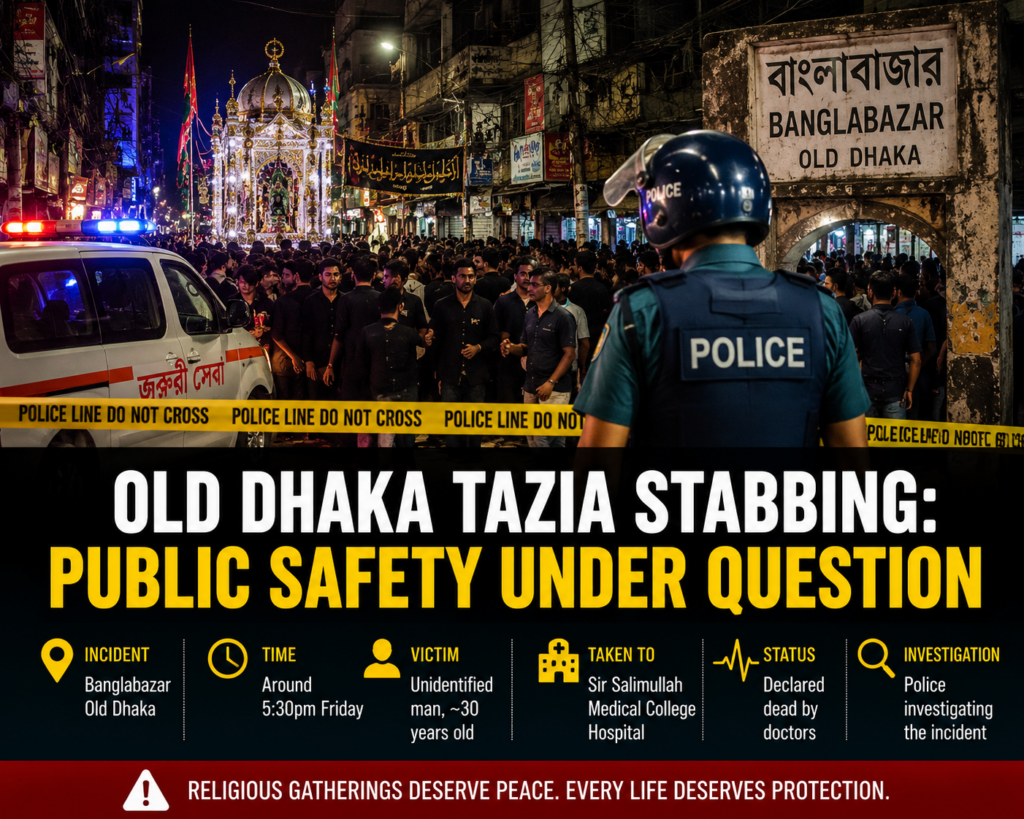
Old Dhaka Tazia Stabbing Shows How Quickly Public Gatherings Can Turn Unsafe
|
Getting your Trinity Audio player ready...
|
A religious procession should not end with a man lying dead on the road.
Yet that is what Old Dhaka is now facing after an unidentified man was stabbed during a Tazia procession in Banglabazar. He was taken to Sir Salimullah Medical College Hospital, where doctors declared him dead.
Police have not yet confirmed his identity. They estimate he was around 30 years old. The cause of the attack, the person responsible and the full circumstances still need proper investigation.
But one thing is already clear.
A public gathering became unsafe, and a life was lost.
A Death in the Middle of a Procession
Old Dhaka is not an ordinary place during religious events.
Its streets are narrow. Its crowds are dense. Its neighbourhoods are emotionally alive. Processions can move through tight spaces where one push, one argument, one rumour or one weapon can create danger very quickly.
That is why security around large gatherings cannot be casual.
A Tazia procession is part of a deeply meaningful religious tradition for many people. It carries grief, history, devotion and community emotion. But no tradition, however important, can be separated from public safety.
People must be able to gather.
People must also be able to return home alive.
The First Duty Is to Identify the Victim
Before politics, before rumours, before social media noise, the first duty is human.
Who was this man?
Where was his family?
Why was he there?
Was he part of the procession, a passer-by, a local resident or someone pulled into a sudden confrontation?
These questions matter because an unidentified dead person should never become only “a body” in a police file. He was someone’s son, brother, friend or neighbour. His name must not disappear under the weight of another violent headline.
The police must identify him quickly and inform his family with dignity.
Public Safety Cannot Depend on Luck
Bangladesh has too many public gatherings where safety depends more on luck than planning.
Religious processions, political rallies, student marches, cultural events and local festivals often bring large crowds into streets that are not designed to handle pressure. In those moments, small failures can become deadly.
Was there enough crowd control?
Were police positioned properly?
Were entry and exit routes clear?
Was emergency medical support nearby?
Were sharp weapons or dangerous objects checked?
Was the area monitored before and during the procession?
These are not minor questions. They are the questions that decide whether a public event remains peaceful or becomes a tragedy.
Do Not Turn This Into Communal Noise
This case must be handled carefully.
Because the incident happened during a religious procession, some people may try to twist it into communal propaganda, sectarian blame or political theatre. That would be irresponsible.
A man has died.
The priority should be facts, investigation and justice.
No community should be blamed without evidence. No religious group should be targeted. No rumour should be allowed to outrun the truth.
Bangladesh already has enough tension. It does not need another death turned into a weapon by careless voices online.
The police should speak clearly and regularly so that misinformation does not fill the silence.
Violence in Crowds Is a Serious Warning
Crowd violence is dangerous because it happens fast.
In a dense street, people may not even understand what has happened until someone falls. Panic spreads. Movement becomes difficult. Ambulances struggle to enter. Witnesses give confused accounts. Suspects can disappear into the crowd.
This is why prevention matters more than reaction.
Public-event security must include visible policing, route planning, emergency access, local coordination, CCTV review, volunteer marshals and quick medical response.
Bangladesh cannot keep treating these tragedies as isolated incidents. Every public gathering teaches a lesson. The question is whether the authorities learn before the next one.
Old Dhaka Deserves Better Safety
Old Dhaka is one of the most historic and culturally rich parts of the capital. It is full of memory, food, trade, religion, language and community life.
But it is also overcrowded, congested and vulnerable during major events.
Residents deserve public celebrations and religious processions that do not turn their streets into danger zones. Devotees deserve the right to practise tradition peacefully. Businesses deserve safety. Families deserve confidence that a procession will not become a crime scene.
That requires planning, not only policing after something goes wrong.
Justice Must Be Fast and Clean
The investigation should move quickly.
Police must identify the victim, collect witness statements, review any available CCTV footage, examine the route, find the attacker and explain how a sharp weapon entered or appeared inside the procession environment.
If this was a personal dispute, say so.
If it was a random attack, say so.
If there was organised intent, prove it.
The public does not need vague statements. It needs credible answers.
Justice delayed will only create suspicion.
The Real Lesson
This killing should not be allowed to become just another one-day headline.
It should force a serious conversation about public safety in Bangladesh.
Religious gatherings must be protected.
Crowds must be managed.
Emergency response must be ready.
Rumours must be stopped.
And the dead must not be forgotten.
A society is judged not only by how it celebrates faith, culture and public life, but also by how it protects people inside those gatherings.
Old Dhaka has seen enough tragedy in its narrow streets.
This time, the answer cannot be silence.
It must be accountability.